Nunc eu turpis id nulla sodales luctus. Vestibulum fermentum dui faucibus ligula dapibus scelerisque. Etiam laoreet vitae est vitae convallis.

Sample text. Click to select the Text Element. Lorem ipsum dolor sit amet, consectetur adipiscing elit, sed do eiusmod tempor incididunt ut labore et dolore magna aliqua. Ut enim ad minim veniam, quis nostrud exercitation ullamco laboris nisi ut aliquip ex ea commodo consequat.
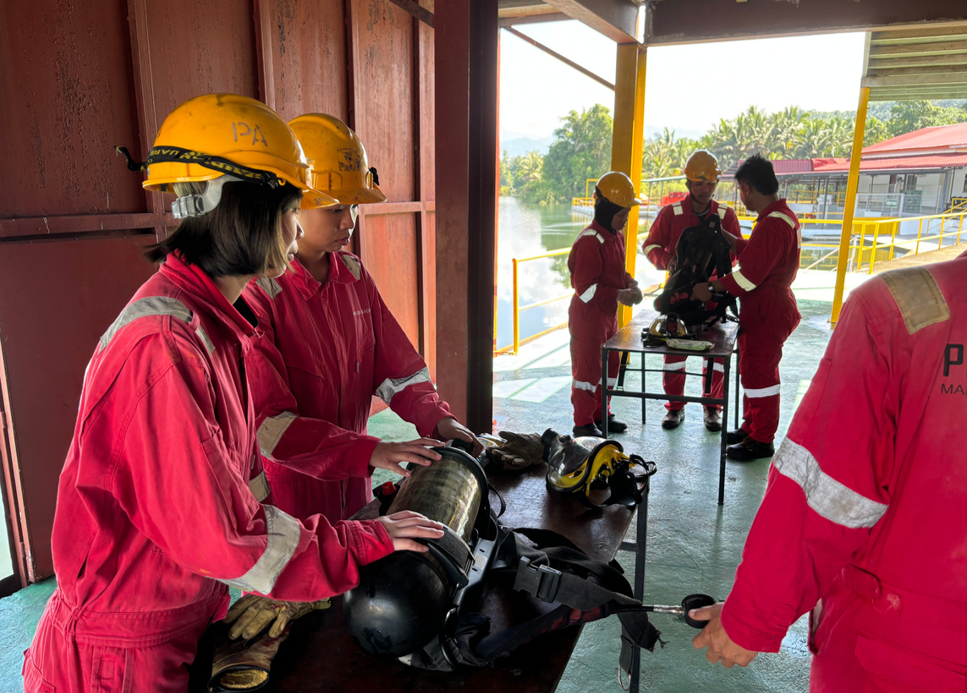
This is an OPITO accredited programme. The theory or underpinning knowledge is delivered digitically and can be taken from anywhere. The practical component will be done at BSTC training centre after successful completion of the digital part.
Book now Training Aim:
The aim of the Dry CA-EBS Initial Deployment is for personnel that are issued with Compressed Air Emergency Breathing System (CA-EBS) whilst travelling to work by helicopter and may be required to use a CA-EBS in the event of an emergency.
Training Aim:
The aim of the HUET (with EBS) program is to prepare delegates that intend to travel to and from offshore oil and gas installations and vessels by helicopter by providing specific training in pre-flight and in-flight requirements and to equip delegates with the basic emergency response knowledge and skills required in the event of a helicopter emergency – with specific focus on escaping from a helicopter following ditching.
Training Aim:
The aim of the HUET (with CA-EBS) is to meet the offshore safety and emergency response training requirements for personnel working in the offshore oil and gas industry who will be supplied with a compressed air emergency breathing system (CA-EBS) during offshore works.
Training Aim:
The aim of the IMIST program is to introduce delegates to the key safety elements required by all employees working in the oil and gas industry. It also ensures the knowledge and understanding of these basic safety elements are maintained and current amongst the existing workforce.
Training Aim:
The aim of the T-BOSIET is to introduce delegates to the specific safety issues and regimes relevant to offshore installations, and to equip them with the basic emergency response knowledge and skills for travelling to and from offshore installations by helicopter in a tropical environment and Travel Safely by Boat.
Training Aim:
The aims and objectives of the Travel Safely by Boat (TSbB) training standard are to ensure that all personnel travelling/transferring by boat to work in offshore areas achieve the following:
1. Awareness of the risks to which they are exposed and how they are managed
2. An understanding of the essential safety rules with which they must comply and how to act in an emergency
3. An increase in their personal commitment to safety
4. Effective use of personal safety equipment
5. Practice and demonstrate correct method of boat transfers (simulated boat deck and installation).
Training Aim:
The aim of the TSbB Further Training Course is to refresh the safety and emergency response skills of personnel who have previously successfully completed their TSbB Initial Training.
Training Aim:
The aim of the BOSIET (with EBS) is to introduce delegates to the specific safety issues and regimes relevant to offshore installations, and to equip them with the basic emergency response knowledge and skills for travelling to and from offshore installations by helicopter and travel safely by Boat.
Training Aim:
The aim of the BOSIET (with CA-EBS) is to meet the initial offshore safety and emergency response training requirements for personnel new (or returning) to the offshore oil and gas industry who will be supplied with a compressed air emergency breathing system (CA-EBS) during offshore helicopter travel.
Training Aim:
The aim of the BOSIET (with CA-EBS) Digital Delivery is to meet the initial offshore safety and emergency response training requirements for personnel new (or returning) to the offshore oil and gas industry who will be supplied with a compressed air emergency breathing system (CA-EBS) during offshore helicopter travel and who choose to complete the underpinning knowledge of the BOSIET program via the BOSIET (with CA-EBS) on-line program prior to attending an OPITO-approved training centre to be formally assessed against all outcomes.
Training Aim:
The aim of the FOET (with EBS) is to provide the delegates with the opportunity to practice and demonstrate emergency response skills which are not possible to practice during drills, exercises and emergency training offshore and Travel Safely by Boat.
Training Aim:
The aim of the FOET (with CA-EBS) is to meet the further offshore safety and emergency response training requirements for personnel working in the offshore oil and gas industry who will be supplied with a compressed air emergency breathing system (CA-EBS) during offshore helicopter travel.
Training Aim:
The aim of the T-BOSIET (with EBS) is to introduce delegates to the specific safety issues and regimes relevant to offshore installations, and to equip them with the basic emergency response knowledge and skills for travelling to and from offshore installations by helicopter in a tropical environment and Travel Safely by Boat.
OPITO Basic H2S Training is designed to equip personnel working in environments with potential exposure to hydrogen sulfide (H2S) gas with the necessary knowledge and skills for emergency response.
Key Objectives:
Training Content:
Training Aim: The Qualified Rigger Banksman course is aimed to provide individuals with the knowledge and skills to prepare the load for safe lifting by any form of lifting equipment using correct and clear signals to guide the crane operator in the maneuvering of a load safely to its destination.
Course Pre-Requisite :
Validity : 2 Years
Training Aim: The aim of the Crane Operation Safety Training Program is to provide the delegate, who has little or no previous knowledge or experience in crane operations, with the basic knowledge and skills required of Crane Operator.
Course Pre-Requisite : Copy Valid Passport or NRIC & Valid MCU (Medical Check Up)
Validity : 2 Years